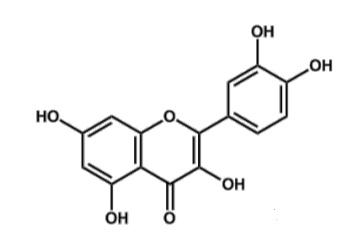
Caractéristiques
- INCI
- Quercetin
- CAS
-
117-39-5
Il s'agit du numéro de la substance dans le registre du Chemical Abstracts Service. Le numéro CAS identifie de manière unique une substance indépendamment de la langue, du nom commercial ou des synonymes.
- EC
-
204-187-1
Il s'agit du numéro de substance dans le système européen d'identification chimique (numéro CE), utilisé dans les bases de données réglementaires européennes, y compris ECHA/CosIng.
- IUPAC
- 4H-1-Benzopyran-4-One, 2-(3,4-Dihydroxyphenyl)-3,5,7-Trihydroxy-
- Fonctions
- antioxydant, conditionnement de la peau
Descriptif
La quercétine est un flavonoïde polyphénolique présent dans de nombreuses plantes, telles que les oignons rouges, le brocoli et les myrtilles. La raison pour laquelle elle est utilisée dans les cosmétiques est que, comme d'autres polyphénols, elle est un antioxydant puissant et a des propriétés anti-inflammatoires. En outre, une étude a également montré que l'ajout de quercétine aux écrans solaires a aidé à stabiliser les filtres chimiques UV autrement peu stables, l'avonbenzone et l'octinoxate, contre la dégradation - et c'était mieux que les stabilisants traditionnels comme l'octocrylate et la vitamine E! Il existe également des études sur l'utilisation de la quercétine comme agent de blanchiment de la peau, mais après des résultats contradictoires, la conclusion est que la quercétine n'est pas un antioxydant puissant et a des propriétés anti-inflammatoires.
Preuves scientifiques sur Quercetin
Publications et sources scientifiques
5
-
1
Bonina, Francesco, Maria Lanza, Lucia Montenegro, Claudio Puglisi, Antonio Tomaino, Domenico Trombetta, Francesco Castelli, and Antonella Saija. 1996. “Flavonoids as Potential Protective Agents against Photo-Oxidative Skin Damage.” International Journal o
-
2
Boots, Agnes W., Lonneke C. Wilms, Els L. R. Swennen, Jos C. S. Kleinjans, Aalt Bast, and Guido R. M. M. Haenen. 2008. “In Vitro and Ex Vivo Anti-Inflammatory Activity of Quercetin in Healthy Volunteers.” Nutrition 24 (7): 703–10.Trouver dans PubMed
-
3
Choi, Moon-Hee, and Hyun-Jae Shin. 2016. “Anti-Melanogenesis Effect of Quercetin.” Cosmetics 3 (2): 18.Trouver dans PubMed
-
4
Kitagawa, Shuji, Yuko Tanaka, Manami Tanaka, Kanako Endo, and Akiko Yoshii. 2009. “Enhanced Skin Delivery of Quercetin by Microemulsion.” Journal of Pharmacy and Pharmacology 61 (7): 855–60.Trouver dans PubMed
-
5
Scalia, Santo, and Matteo Mezzena. 2010. “Photostabilization Effect of Quercetin on the UV Filter Combination, Butyl Methoxydibenzoylmethane–Octyl Methoxycinnamate.” Photochemistry and Photobiology 86 (2): 273–78.Trouver dans PubMed
Produits avec Quercetin (165 total des dépenses)
Cheveux
Soins du visage
Soins du corps
Mains et ongles
Présent surtout dans les produits Sesderma (17 produits)


ROUND LAB Camellia Deep Collagen Firming Cream
ROUND LAB
→
ROUND LAB Camellia Deep Collagen Firming Gel Mask -
ROUND LAB
→
ROUND LAB Camellia Deep Collagen Firming Sun Serum
ROUND LAB
→
ROUND LAB Camellia Deep Collagen Jelly Mask Cleanser
ROUND LAB
→
ROUND LAB Camillia Deep Firming Collagen Sun Serum
ROUND LAB
→
Sesderma C Vit Eye Contour
Sesderma
→