Bis-Ethylhexyloxyphenol Methoxyphenyl Triazine
Tinosorb S, Bemotrizinol
Caractéristiques
- INCI
- Bis-Ethylhexyloxyphenol Methoxyphenyl Triazine
- Ru.
- Tinosorb S, Bemotrizinol
- CAS
-
187393-00-6
Il s'agit du numéro de la substance dans le registre du Chemical Abstracts Service. Le numéro CAS identifie de manière unique une substance indépendamment de la langue, du nom commercial ou des synonymes.
- IUPAC
- 2,2'-[6-(4-Methoxyphenyl)-1,3,5-Triazine-2,4-Diyl]Bis[5-[(2-Ethylhexyl)Oxy]-Phenol]
- Fonctions
- skin conditioning, uv absorber, uv filter
- Restr. de l'UE
-
VI/25
Statut réglementaire de l'UE: utilisation restreinte. L'ingrédient est autorisé dans les cosmétiques de l'UE, mais son utilisation et son étiquetage sont réglementés.
Plus de détails →
Pour qui
Descriptif
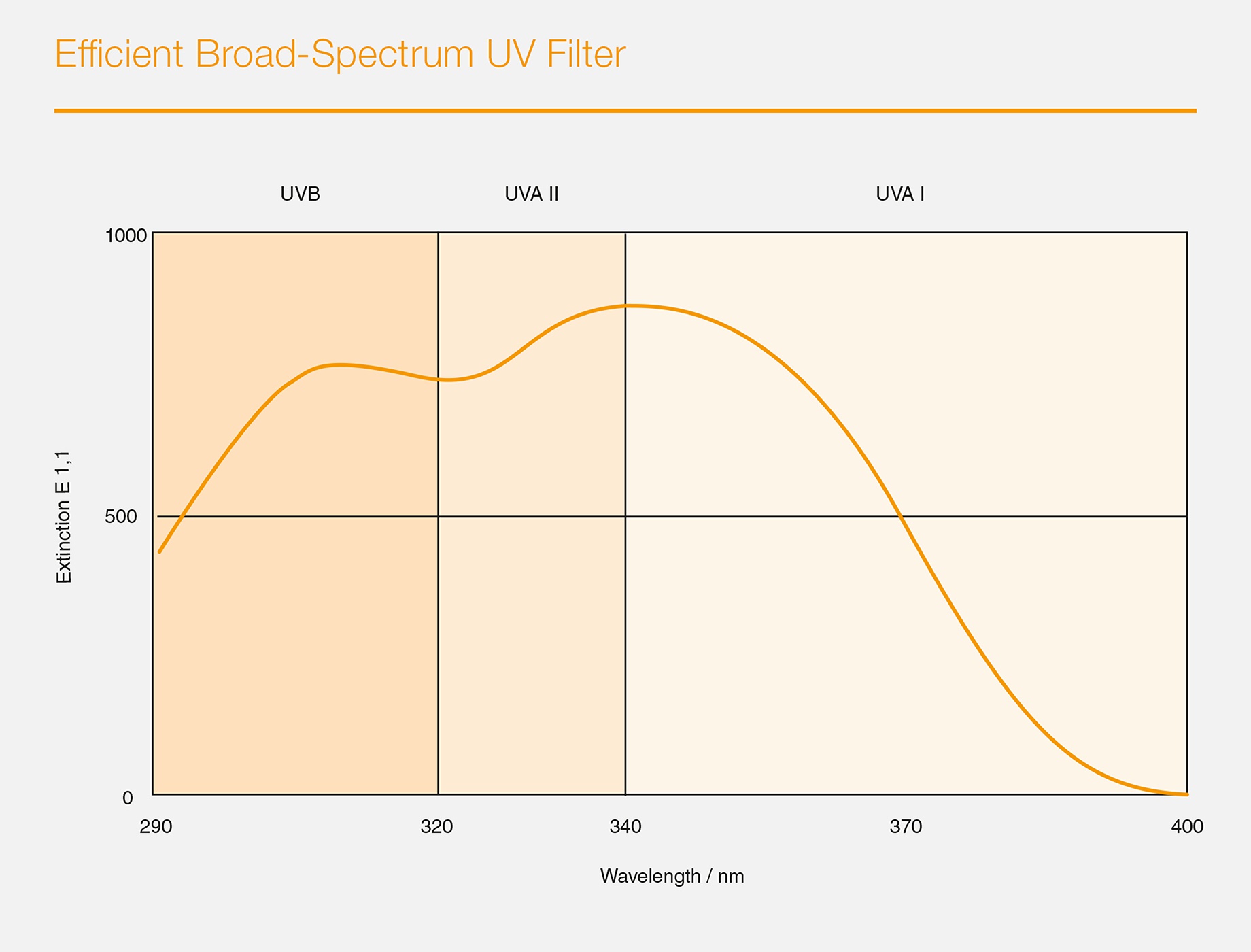
If sunscreen filters had a glamour award, this one would probably show up wearing sunglasses indoors. Bis-Ethylhexyloxyphenol Methoxyphenyl Triazine is a modern, oil-soluble UV filter that delivers very strong broad-spectrum protection, covering both UVB and UVA rays. It has absorption peaks around 310 nm and 345 nm, which means it does a particularly good job in the parts of the UV range that contribute to sunburn and long-term skin damage. In plain English: it helps your sunscreen actually act like a proper sunscreen, not a polite suggestion.
One of its biggest claims to fame is photostability. Some older filters break down as soon as sunlight hits them, which is a bit awkward for a sunscreen ingredient. This one stays impressively intact under UV exposure and can even help stabilize other filters, including the famously finicky avobenzone. That makes it especially useful in formulas that are trying to achieve high SPF and reliable UVA protection without falling apart halfway through your beach walk. In a 2007 comparison of 18 EU-available sunscreen agents, this filter came out looking particularly strong: at the highest allowed concentration, it delivered an SPF of 20 on its own, which is no small feat for a single filter.
It’s also a bit of a globe-trotter. You’ll find it in sunscreens in Europe, Australia, and many Asian markets, but not in the US, where the sunscreen approval process has made newer UV filters frustratingly slow to reach shelves. That has nothing to do with its performance and everything to do with regulation. From a formulation point of view, it’s a slightly yellowish powder that is not meant to sink deeply into your skin, because sunscreen ingredients do their best work sitting on the surface and forming a protective film. That’s exactly where this one likes to be.
Safety-wise, the news is reassuring. It has a great safety profile and, unlike some older chemical filters that got people worried about hormone-like activity, it has not shown estrogenic activity in the usual testing. So the short version is this: if you see this mouthful on a label, your sunscreen is probably trying very hard to be effective, stable, and well-behaved. Not bad for a molecule with a name that looks like it lost a fight with a keyboard.
Plus de détails
Son nom INCI est a un peu d'une bouchée, mais la bis-éthylhexyloxyphénol Méthoxyphényl Triazine mérite d'être reconnue telle qu'elle est l'un des meilleurs agents de protection solaire connus aujourd'hui. Malheureusement, il n'est pas approuvé par la FDA, vous ne le trouverez donc pas dans les écrans solaires en provenance des États-Unis (non pas parce que ce n'est pas bon, mais parce que la réglementation américaine empêche les nouveaux agents de protection solaire d'être approuvés), mais il est largement disponible dans d'autres parties du monde comme l'Europe, l'Australie ou l'Asie.
C'est un large spectre (couvre toute la gamme UVB et UVA, 280-400 nm) agent de protection solaire chimique avec des protections maximales à environ 310 et 345 nm et contrairement aux filtres UV plus anciens, c'est très photostable.Il se détériore à peine en présence de lumière UV et il est également utile pour stabiliser d'autres agents de protection solaire moins stables, comme le célèbre protecteur UVA, l'avobenzone.
C'est un agent de protection solaire de nouvelle génération spécialement conçu pour un FPS élevé et une bonne protection contre les UVA et basé sur une étude de 2007 qui comparé 18 agents de protection solaire disponibles dans l'UE, il avait vraiment la meilleure protection SPF (ils ont utilisé la concentration la plus élevée autorisée par la réglementation de l'UE pour chacun des 18 écrans solaires et Trinosorb S a donné un FPS 20 à lui seul).
C'est une poudre légèrement jaunâtre soluble dans l'huile qui n'est pas trop absorbée par la peau. C'est une bonne nouvelle pour un agent de protection solaire car il doit être à la surface de la peau pour faire son travail correctement. En ce qui concerne les effets secondaires du Bis-éthylhexyloxyphénol Méthoxyphényl Triazine, nous avons également de bonnes nouvelles ici: il a un excellent profil de sécuritéet contrairement à quelques autres écrans solaires chimiques, Trinosorb S (et M) ne présente pas d'activité œstrogénique.
Dans l'ensemble, nous pensons Trinosorb S est l'une des meilleures options de protection solaire disponible aujourd'hui.
Aimez-vous les agents de protection solaire? Nous avons également des explications brillantes (ainsi que des listes de produits) sur les autres:
- Méthylène Bis-Benzotriazolyl Tétraméthylbutylphénol, alias Tinosorb M, le bon copain de notre molécule actuelle Tinosorb S
- Tris-Biphényl Triazine, alias Tinosorb A2B, le plus récent ajout à la famille Tinosorb qui protège fortement dans une longueur d'onde intermédiaire que la plupart des autres filtres manquent
- Éthylhexyl Triazone, alias Uvinul T 150, un autre agent de protection solaire de nouvelle génération avec une protection UVB très élevée
- Diéthylamino Hydroxybenzoyl Hexyl Benzoate, alias Uvinul A Plus, un écran solaire de nouvelle génération pour la protection contre les UVA
Preuves scientifiques sur Bis-Ethylhexyloxyphenol Methoxyphenyl Triazine
-
1
Pharmazie 62: 449–452 (2007), Study of the efficacy of 18 sun filters authorized in European Union tested in vitro
-
2
Regulatory Toxicology and Pharmacology 34, 287–291 (2001), Lack of Binding to Isolated Estrogen or Androgen Receptors, and Inactivity in the Immature Rat Uterotrophic Assay, of the Ultraviolet Sunscreen Filters Tinosorb M-Active and Tinosorb S
-
3
Chatelain, Eric, and Bernard Gabard. "Photostabilization of Butyl methoxydibenzoylmethane (Avobenzone) and Ethylhexyl methoxycinnamate by Bis‐ethylhexyloxyphenol methoxyphenyl triazine (Tinosorb S), a New UV Broadband Filter¶." Photochemistry and Photobio
Produits avec Bis-Ethylhexyloxyphenol Methoxyphenyl Triazine (6 103 total des dépenses)
Présent surtout dans les produits Avene (130 produits)