Bis-Ethylhexyloxyphenol Methoxyphenyl Triazine
Tinosorb S, Bemotrizinol
Characteristics
- INCI
- Bis-Ethylhexyloxyphenol Methoxyphenyl Triazine
- Ru.
- Tinosorb S, Bemotrizinol
- CAS
-
187393-00-6
This is the substance number in the Chemical Abstracts Service registry. The CAS number uniquely identifies a substance regardless of language, trade name, or synonyms.
- IUPAC
- 2,2'-[6-(4-Methoxyphenyl)-1,3,5-Triazine-2,4-Diyl]Bis[5-[(2-Ethylhexyl)Oxy]-Phenol]
- Functions
- skin conditioning, uv absorber, uv filter
- EU Restr.
-
VI/25
EU regulatory status: restricted use. The ingredient is permitted in EU cosmetics but its use and labelling are regulated.
More detail →
Who it's for
Description
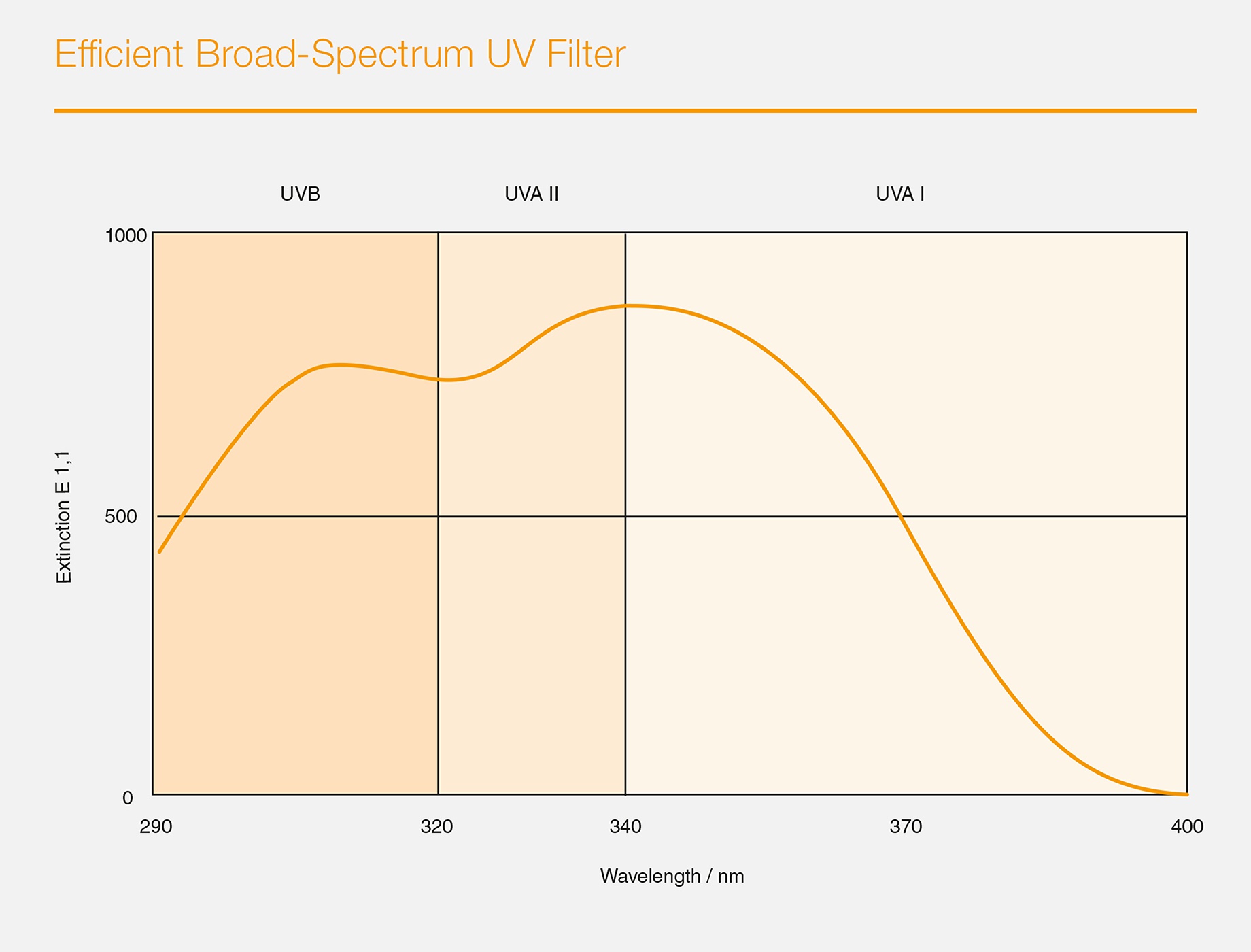
If sunscreen filters had a glamour award, this one would probably show up wearing sunglasses indoors. Bis-Ethylhexyloxyphenol Methoxyphenyl Triazine is a modern, oil-soluble UV filter that delivers very strong broad-spectrum protection, covering both UVB and UVA rays. It has absorption peaks around 310 nm and 345 nm, which means it does a particularly good job in the parts of the UV range that contribute to sunburn and long-term skin damage. In plain English: it helps your sunscreen actually act like a proper sunscreen, not a polite suggestion.
One of its biggest claims to fame is photostability. Some older filters break down as soon as sunlight hits them, which is a bit awkward for a sunscreen ingredient. This one stays impressively intact under UV exposure and can even help stabilize other filters, including the famously finicky avobenzone. That makes it especially useful in formulas that are trying to achieve high SPF and reliable UVA protection without falling apart halfway through your beach walk. In a 2007 comparison of 18 EU-available sunscreen agents, this filter came out looking particularly strong: at the highest allowed concentration, it delivered an SPF of 20 on its own, which is no small feat for a single filter.
It’s also a bit of a globe-trotter. You’ll find it in sunscreens in Europe, Australia, and many Asian markets, but not in the US, where the sunscreen approval process has made newer UV filters frustratingly slow to reach shelves. That has nothing to do with its performance and everything to do with regulation. From a formulation point of view, it’s a slightly yellowish powder that is not meant to sink deeply into your skin, because sunscreen ingredients do their best work sitting on the surface and forming a protective film. That’s exactly where this one likes to be.
Safety-wise, the news is reassuring. It has a great safety profile and, unlike some older chemical filters that got people worried about hormone-like activity, it has not shown estrogenic activity in the usual testing. So the short version is this: if you see this mouthful on a label, your sunscreen is probably trying very hard to be effective, stable, and well-behaved. Not bad for a molecule with a name that looks like it lost a fight with a keyboard.
More detail
Its INCI name is a bit of a mouthful, but Bis-Ethylhexyloxyphenol Methoxyphenyl Triazine is worth recognizing it as it is one of the best sunscreen agents known today. Unfortunately, it's not FDA-approved so you will not find it in sunscreens coming from the US (not because it's not good, but because US regulations make it impossible for newer sunscreen agents to get approved), but it is widely available in other parts of the world like Europe, Australia or Asia.
It is a broad-spectrum (covers the whole UVB and UVA range, 280-400 nm) chemical sunscreen agent with peak protections at about 310 and 345 nm and unlike older UV filters, it's very photostable.It hardly deteriorates in the presence of UV light and it's also useful in stabilizing other less stable sunscreen agents, like the famous UVA protector, avobenzone.
It's a new generation sunscreen agent that was specifically designed for high SPF and good UVA protection and based on a 2007 study that compared 18 sunscreen agents available in the EU it really had the best SPF protection (they used the highest concentration allowed by EU regulations from each 18 sunscreens and Trinosorb S gave an SPF 20 all by itself).
It is an oil-soluble, slightly yellowish powder that is not absorbed into the skin too much. This is good news for a sunscreen agent as it needs to be on the surface of the skin to do its job properly. Regarding Bis-Ethylhexyloxyphenol Methoxyphenyl Triazine side effects, we have good news here as well: it has a great safety profileand unlike a couple of other chemical sunscreens, Trinosorb S (and M) does not show estrogenic activity.
Overall, we think Trinosorb S is one of the best sunscreen options available today.
Are you into sunscreen agents? We have shiny explanations (along with product lists) about others as well:
- Methylene Bis-Benzotriazolyl Tetramethylbutylphenol, aka Tinosorb M, the good buddy of our current molecule Tinosorb S
- Tris-Biphenyl Triazine, aka Tinosorb A2B, the newest addition to the Tinosorb family that protects strongly in an in-between wavelength that most other filters miss
- Ethylhexyl Triazone, aka Uvinul T 150, another new generation sunscreen agent with super-high UVB protection
- Diethylamino Hydroxybenzoyl Hexyl Benzoate, aka Uvinul A Plus, a new generation sunscreen for UVA protection
Evidence & Research on Bis-Ethylhexyloxyphenol Methoxyphenyl Triazine
-
1
Pharmazie 62: 449–452 (2007), Study of the efficacy of 18 sun filters authorized in European Union tested in vitro
-
2
Regulatory Toxicology and Pharmacology 34, 287–291 (2001), Lack of Binding to Isolated Estrogen or Androgen Receptors, and Inactivity in the Immature Rat Uterotrophic Assay, of the Ultraviolet Sunscreen Filters Tinosorb M-Active and Tinosorb S
-
3
Chatelain, Eric, and Bernard Gabard. "Photostabilization of Butyl methoxydibenzoylmethane (Avobenzone) and Ethylhexyl methoxycinnamate by Bis‐ethylhexyloxyphenol methoxyphenyl triazine (Tinosorb S), a New UV Broadband Filter¶." Photochemistry and Photobio
Products with Bis-Ethylhexyloxyphenol Methoxyphenyl Triazine (6 103 total)
Most often found in Avene products (130 items)