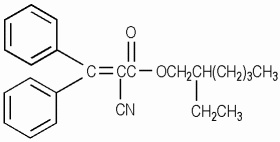
Caractéristiques
- INCI
- Octocrylene
- CAS
-
6197-30-4
Il s'agit du numéro de la substance dans le registre du Chemical Abstracts Service. Le numéro CAS identifie de manière unique une substance indépendamment de la langue, du nom commercial ou des synonymes.
- EC
-
228-250-8
Il s'agit du numéro de substance dans le système européen d'identification chimique (numéro CE), utilisé dans les bases de données réglementaires européennes, y compris ECHA/CosIng.
- IUPAC
- 2-Cyano-3,3-Diphenyl Acrylic Acid 2-Ethylhexyl Ester
- Fonctions
- absorbeur d'UV, filtre UV
- Restr. de l'UE
-
VI/10
Statut réglementaire de l'UE: utilisation restreinte. L'ingrédient est autorisé dans les cosmétiques de l'UE, mais son utilisation et son étiquetage sont réglementés.
Plus de détails →
Pour qui
Descriptif
Une agent de protection solaire chimique soluble dans l'huile cela protège la peau dans la gamme UVB et un peu dans la gamme UVA II avec un pic d'absorption de 304 nm. Ses la protection n'est pas assez forte en soi mais il est assez photostable (perd 10% de la protection FPS en 95 minutes) et est souvent utilisé pour stabiliser d'autres filtres UV photo-instables, par exemple, l'Avobenzone. Il est également souvent utilisé pour améliorer la résistance à l'eau des produits.
Le profil d'innocuité de l'octocrylène est généralement assez bon, bien qu'une étude de synthèse sur la dermatite de contact rapporte un "nombre croissant de patients allergiques par photo-contact à l'octocrylène."Ce sont principalement les adultes sensibles au kétoprofène et les enfants à la peau sensible qui sont touchés, donc si vous avez un petit enfant, il est probablement préférable d'utiliser des écrans solaires sans octocrylène.
Plus de détails
Questions fréquentes sur Octocrylene
Que fait l'octocrylène dans la crème solaire?
L'octocrylène est-il sans danger pour la peau?
L'octocrylène peut-il provoquer une réaction allergique?
L'octocrylène est-il mauvais pour votre peau?
L'octocrylène est-il identique à l'octinoxate?
Preuves scientifiques sur Octocrylene
-
1
Couteau, C., et al. "Study of the efficacy of 18 sun filters authorized in European Union tested in vitro." Die Pharmazie-An International Journal of Pharmaceutical Sciences 62.6 (2007): 449-452.Trouver dans PubMed
-
2
Couteau, Céline, et al. "Study of the photostability of 18 sunscreens in creams by measuring the SPF in vitro." Journal of pharmaceutical and biomedical analysis 44.1 (2007): 270-273.Trouver dans PubMed
-
3
Scalia, Santo, and Matteo Mezzena. "Incorporation in lipid microparticles of the UVA filter, butyl methoxydibenzoylmethane combined with the UVB filter, octocrylene: effect on photostability." AAPS PharmSciTech 10.2 (2009): 384-390.Trouver dans PubMed
-
4
de Groot, Anton C., and David W. Roberts. "Contact and photocontact allergy to octocrylene: a review." Contact dermatitis 70.4 (2014): 193-204.Trouver dans PubMed
Produits avec Octocrylene (5 777 total des dépenses)
Présent surtout dans les produits Nivea (124 produits)


