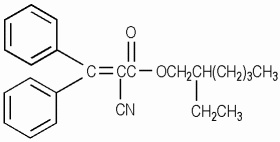
Características
- INCI
- Octocrylene
- CAS
-
6197-30-4
Este es el número de sustancia en el registro del Chemical Abstracts Service. El número CAS identifica de forma exclusiva una sustancia independientemente del idioma, el nombre comercial o los sinónimos.
- EC
-
228-250-8
Este es el número de sustancia en el sistema europeo de identificación química (número CE), que se utiliza en las bases de datos regulatorias europeas, incluida la ECHA / CosIng.
- IUPAC
- 2-Cyano-3,3-Diphenyl Acrylic Acid 2-Ethylhexyl Ester
- Funciones
- absorbente de uv, filtro uv
- Restricción de la UE.
-
VI/10
Estado reglamentario de la UE: uso restringido. El ingrediente está permitido en los cosméticos de la UE, pero su uso y etiquetado están regulados.
Más detalles →
Para quién
Descripción
Un agente protector solar químico soluble en aceite eso protege la piel en el rango UVB y algo en el UVA II con una absorción máxima de 304 nm. Su la protección no es lo suficientemente fuerte por sí sola pero es bastante fotoestable (pierde un 10% de protección SPF en 95 minutos) y a menudo se usa para estabilice otros filtros UV fotoinestables, por ejemplo, Avobenzona. También se usa a menudo para mejorar la resistencia al agua de los productos.
El perfil de seguridad del octocrileno es generalmente bastante bueno, aunque un estudio de revisión en Dermatitis de contacto informa de un " número creciente de pacientes con alergia al octocrileno por contacto fotográfico."Principalmente los adultos con sensibilidad al ketoprofeno y los niños con piel sensible se ven afectados, por lo que si tiene un niño pequeño, probablemente sea mejor usar protectores solares sin octocrileno.
Más detalles
Un agente solar químico soluble en aceite que protege la piel en el rango UVB y algo en el rango UVA II con una absorción máxima de 304 nm. Su protección no es lo suficientemente fuerte por sí sola, pero es bastante fotostable (pierde el 10% de la protección SPF en 95 minutos) y se utiliza a menudo para estabilizar otros filtros UV fotoinestables, por ejemplo, Avobenzona. También se utiliza a menudo para mejorar la resistencia al agua de los productos. El perfil de seguridad del octocrileno es generalmente bastante bueno, aunque una revisión de un estudio en Contact Dermatitis informa de un "aumento en el número de pacientes con fotoalergia al contacto con el octocrileno". Principalmente adultos con sensibilidad al octocrileno y niños con piel sensible al octocrileno, por lo que si tiene un niño pequeño afectado, es probablemente mejor usarlo sin octocrileno.
Preguntas frecuentes sobre Octocrylene
¿Qué hace el octocrileno en el protector solar?
¿El octocrileno es seguro para la piel?
¿Puede el octocrileno causar una reacción alérgica?
¿El octocrileno es malo para la piel?
¿Es el octocrileno lo mismo que el octinoxato?
Evidencia e investigación sobre Octocrylene
-
1
Couteau, C., et al. "Study of the efficacy of 18 sun filters authorized in European Union tested in vitro." Die Pharmazie-An International Journal of Pharmaceutical Sciences 62.6 (2007): 449-452.Buscar en PubMed
-
2
Couteau, Céline, et al. "Study of the photostability of 18 sunscreens in creams by measuring the SPF in vitro." Journal of pharmaceutical and biomedical analysis 44.1 (2007): 270-273.Buscar en PubMed
-
3
Scalia, Santo, and Matteo Mezzena. "Incorporation in lipid microparticles of the UVA filter, butyl methoxydibenzoylmethane combined with the UVB filter, octocrylene: effect on photostability." AAPS PharmSciTech 10.2 (2009): 384-390.Buscar en PubMed
-
4
de Groot, Anton C., and David W. Roberts. "Contact and photocontact allergy to octocrylene: a review." Contact dermatitis 70.4 (2014): 193-204.Buscar en PubMed
Productos con Octocrylene (5 777 total)
Más frecuente en productos Nivea (124 productos)


