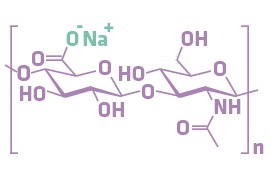
Caractéristiques
- INCI
- Sodium Hyaluronate
- CAS
-
9067-32-7
Il s'agit du numéro de la substance dans le registre du Chemical Abstracts Service. Le numéro CAS identifie de manière unique une substance indépendamment de la langue, du nom commercial ou des synonymes.
- IUPAC
- Hyaluronic Acid, Sodium, Salt
- Fonctions
- humectant, conditionnement de la peau
- Irritation
-
0 / 5
Potentiel d'irritation: 0-5, où 5 est la cote d'irritation la plus élevée pour l'ingrédient.
Plus de détails → - Comédogène.
-
0 / 5
Indice de comédogénicité: 0-5. Il est peu probable qu'un ingrédient non comédogène (0-1) provoque de l'acné cosmétique.
Plus de détails →
Pour qui
Descriptif
Si jamais votre peau a l'impression d'auditionner pour le rôle de “désert assoiffé”, cet ingrédient est l'une des solutions classiques. Hyaluronate de sodium est la forme de sel de l'acide hyaluronique, une molécule que votre peau utilise naturellement pour garder l'eau là où elle appartient. Son truc de fête est simple mais impressionnant: il lie beaucoup d'eau, ce qui aide la peau à paraître plus coussinée, plus lisse et moins grincheuse. Dans les soins de la peau, cela se traduit généralement par le genre d'apparence pulpeuse que les gens recherchent lorsqu'ils demandent si c'est bon pour la peau ou le visage. Réponse courte: oui, très souvent, surtout si la sécheresse rend les ridules plus évidentes.
Alors, comment fonctionne l'hyaluronate de sodium? Principalement en agissant comme un humectant, ce qui signifie qu'il tire et retient l'eau dans les couches supérieures de votre peau. C'est pourquoi vous le trouverez dans de nombreux sérums, hydratants et “meilleures” formules hydratantes. Dans un étude de 4 semaines sur un produit topique à base d'acide hyaluronique, les participants ont constaté une amélioration de l'hydratation de la peau et de l'apparence des rides, et l'hyaluronate de sodium fait le même travail sur les listes d'ingrédients partout. Ce n'est pas une gomme miracle pour les rides, mais le avantage principal est très réel: une meilleure hydratation, un meilleur rebond et souvent une surface de peau d'apparence plus agréable. Le meilleur sérum hyaluronate de sodium est généralement celui associé à de bons hydratants comme la glycérine, les céramides ou le squalane, car les ingrédients qui aiment l'eau fonctionnent mieux lorsqu'ils ne sont pas laissés seuls.
Vous verrez également des gouttes oculaires au hyaluronate de sodium et des solutions ophtalmiques utilisées pour les yeux secs, où l'ingrédient aide à lubrifier et à apaiser la surface des yeux. Dans des études, il a été démontré que les gouttes à base d'acide hyaluronique améliorent les symptômes de sécheresse oculaire et la stabilité du film lacrymal, avec des concentrations telles que 0.2% couramment utilisé dans les formules de collyre. Si vous vous demandez comment utiliser des gouttes oculaires au hyaluronate de sodium ou une solution ophtalmique, suivez les instructions du produit et ne touchez pas l'embout à votre œil, car personne n'a besoin d'un rebondissement supplémentaire sur l'infection. En médecine, l'hyaluronate de sodium a également une longue histoire dans les injections d'arthrose, où le le principal avantage est la lubrification et l'amortissement des articulations; certaines personnes obtiennent un soulagement modeste de la douleur, bien que les résultats puissent varier et que ce ne soit pas une alternative magique à d'autres traitements. Que vous recherchiez la meilleure poudre, supplément, collyre ou produit pour la peau d'hyaluronate de sodium, la “meilleure marque” dépend moins du nom sur la boîte que de la pureté, de la concentration et de la question de savoir si la formule répond réellement à vos besoins.
En ce qui concerne l'utilisation de l'hyaluronate de sodium dans les soins de la peau, appliquez-le sur une peau légèrement humide et scellez-le avec une crème hydratante, sinon il peut sembler un peu décevant à l'air sec. Et si vous recherchez une alternative au hyaluronate de sodium, d'autres humectants comme la glycérine ou le panthénol peuvent également faire un travail respectable. Les avantages de l'hyaluronate de sodium sont assez simples: il est bien toléré, polyvalent et vraiment utile pour la déshydratation. Les bienfaits pour la santé de l'hyaluronate de sodium sont les plus forts dans les utilisations liées à l'hydratation, tandis que les avantages des soins de la peau consistent à rendre votre peau moins tendue et à lui donner un aspect un peu plus frais. Pas mal pour une molécule au nom aussi peu glamour.
Plus de détails
Questions fréquentes sur Sodium Hyaluronate
Que fait l'hyaluronate de sodium dans les soins de la peau?
L'hyaluronate de sodium est-il bon pour la peau?
Comment fonctionne l'hyaluronate de sodium?
Quels sont les avantages des gouttes oculaires au hyaluronate de sodium?
L'hyaluronate de sodium peut - il être utilisé dans les traitements de l'arthrose?
Produits avec Sodium Hyaluronate (44 264 total des dépenses)
Présent surtout dans les produits L'Oreal (246 produits)


