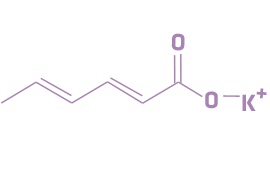
Characteristics
- INCI
- Potassium Sorbate
- CAS
-
24634-61-5, 590-00-1
This is the substance number in the Chemical Abstracts Service registry. The CAS number uniquely identifies a substance regardless of language, trade name, or synonyms.
- EC
-
246-376-1
This is the substance number in the European chemical identification system (EC number), used in European regulatory databases including ECHA/CosIng.
- IUPAC
- Potassium (E,E)-Hexa-2,4-Dienoate
- Functions
- Preservative
- EU Restr.
-
V/4
EU regulatory status: restricted use. The ingredient is permitted in EU cosmetics but its use and labelling are regulated.
More detail →
Description
Ever wondered why that jar of cream, bottle of toner, or fruity gummy doesn’t turn into a science experiment after a few weeks? Potassium sorbate is one of the quiet little helpers behind that feat. It’s the potassium salt of sorbic acid, and in cosmetics it’s used as a preservative mainly to keep mold and yeast from throwing a party in your product. That makes it useful in formulas that contain water, but it’s not a heavy-duty all-rounder. On its own, it’s generally too weak against bacteria, so it works best as part of a preservative system rather than as the lone security guard.
The best pH for potassium sorbate is on the acidic side, usually around pH 4 to 5, with stronger activity when the formula is even a bit more acidic. Why? Because potassium sorbate needs to convert to sorbic acid to do its job properly, and that happens much more efficiently in low-pH products. If the formula is too alkaline, its preservative powers drop off fast. That’s why you’ll often see it in leave-on and rinse-off products that are already mildly acidic, and why people asking how to use potassium sorbate as a preservative usually end up hearing the same advice: pair it with other preservatives and keep the pH in the sweet spot. In cosmetics, typical use levels are often around 0.1% to 0.3%, though the exact amount depends on the product, the formula, and local regulations.
As for potassium sorbate for skin, it’s generally considered low risk and widely used, but it can be a bit irritating for very sensitive skin, especially in products where the preservative system is already a little “busy.” That’s one of the main disadvantages of potassium sorbate: it’s effective only under certain conditions, so it’s not the best standalone option. Still, the scary-sounding internet chatter about potassium sorbate dangers, potassium sorbate cancer, or whether potassium sorbate is bad for you tends to be overblown in the context of regulated cosmetic use. It’s been assessed as safe in typical concentrations, and its long history in food use helps reassure us that this is not some rogue ingredient plotting your downfall.
You’ll also spot potassium sorbate in food, wine, mead, yogurt, bread, cakes, and baking recipes, where it helps slow mold and yeast growth and extend shelf life. In food and beverage use, the amount and method depend on what you’re making and the desired outcome, which is why advice on how to use potassium sorbate in wine making or how to use potassium sorbate in bread can get very specific very quickly. In skincare, though, the story is simpler: it’s a useful preservative helper, not a superstar, but definitely a practical one.
More detail
It's one of those things that help your cosmetics not to go wrong too soon, aka a preservative. It’s not a strong one and doesn’t really work against bacteria, but more against mold and yeast. To do that it has to break down to its active form, sorbic acid. For that to happen, there has to be water in the product and the right pH value (pH 3-4).
But even if everything is right, it’s not enough on its own. If you see potassium sorbate you should see some other preservative next to it too.
BTW, it’s also a food preservative and even has an E number, E202.
Frequently Asked Questions about Potassium Sorbate
What does potassium sorbate do in skincare products?
Is potassium sorbate safe for skin?
Can potassium sorbate cause side effects?
Why is potassium sorbate used in cosmetics and personal care products?
Are there any concerns about potassium sorbate in products?
Products with Potassium Sorbate (30 810 total)
Most often found in Natura Siberica products (236 items)


