Guar Hydroxypropyltrimonium Chloride
Caratteristica
- INCI
- Guar Hydroxypropyltrimonium Chloride
- CAS
-
65497-29-2
Questo è il numero della sostanza nel registro del Chemical Abstracts Service. Il numero CAS identifica in modo univoco una sostanza indipendentemente dalla lingua, dal nome commerciale o dai sinonimi.
- Funzione
- antistatic, film forming, skin conditioning, viscosity controlling
- Irritazione
-
0 / 5
Potenziale di irritazione: 0-5, dove 5 è la più alta valutazione di irritazione per l'ingrediente.
Maggiori dettagli →
Для кого подходит
Maggiori dettagli
Guar Hydroxypropyltrimonium Chloride is a cationic derivative of guar gum used in cosmetics primarily as a conditioning agent for hair. It is attracted to negatively charged areas of the hair, forms a thin smoothing film, reduces static electricity, facilitates combing, reduces tangling and makes hair softer and more manageable. It is most commonly found in shampoos, conditioners, masks, shower gels, and mild cleansers. The ingredient is considered safe for normal cosmetic use, and its irritating potential is usually low.
Per esperti
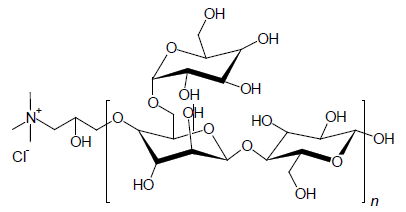
Guar Hydroxypropyltrimonium Chloride is a cationic conditioning polymer of plant origin produced on the basis of guar gum. Guar gum is produced from the seeds of the Cyamopsis tetragonoloba plant, after which the raw materials are chemically modified: the molecule is given a positive charge due to the quaternary ammonium group. It is this cationic nature that makes the ingredient especially valuable in hair products.
In cosmetics, Guar Hydroxypropyltrimonium Chloride is used as an antistatic agent, a film-forming agent, a conditioning agent for hair and skin, as well as a viscosity regulator. Such functions are indicated, in particular, in the European directories of cosmetic ingredients.
The main difference between Guar Hydroxypropyltrimonium Chloride and ordinary guar gum and Hydroxypropyl Guar is its positive charge. The surface of the hair after washing usually has negatively charged areas, especially if the hair is damaged, porous, bleached, colored or has been subjected to heat treatment. The cationic polymer is attracted to such areas and precipitates on the surface of the hair, forming a thin conditioning film. Due to this, the hair becomes smoother, less tangled and easier to comb.
In shampoos, this ingredient is especially useful because it allows you to add a conditioning effect even to a cleansing formula. During washing, Guar Hydroxypropyltrimonium Chloride helps to reduce the feeling of stiffness after surfactants, reduces tangling of wet hair, facilitates subsequent combing and reduces brittleness associated with mechanical damage during combing. Suppliers of raw materials describe it as a water-soluble cationic polymer that improves combability, gives a conditioning effect and at the same time helps to control the viscosity of the formula.
In conditioners, masks and indelible products, Guar Hydroxypropyltrimonium Chloride enhances the feeling of softness, smoothness and manageability of hair. It helps to reduce fluffiness, static electricity and visual “roughness" of the hair web. Unlike some heavy conditioning components, cationic guar usually gives a lighter feel and can be used in formulas where it is important not to overload the hair.
For damaged, colored, bleached and porous hair, this ingredient is especially relevant. The more damaged the surface of the hair is, the more areas with a negative charge on it, to which the cationic polymer can be attracted. Therefore, in formulas for dry, brittle, fluffy and difficult-to-comb hair, Guar Hydroxypropyltrimonium Chloride often works as one of the components that improve the sensory and manageability of hair.
It is important to understand that Guar Hydroxypropyltrimonium Chloride does not “repair” hair in a biological sense. It does not repair the keratin structure from the inside and is not a therapeutic asset. Its effect is mostly superficial: it improves tactile sensation, reduces friction, facilitates combing and helps hair look smoother. Therefore, it is more correct to describe it as a conditioning and protective-sensory component, rather than as a full-fledged restorative asset.
Guar Hydroxypropyltrimonium Chloride is less common in skin products than in hair care, but it can also be used as a component that improves the texture, softness and distribution of the product. It can be present in shower gels, cleansers, creams, lotions, and shaving products, where it helps the formula feel softer and less “dry” after rinsing. Some suppliers also indicate its use in skincare and shaving care as a component that improves viscosity and leaves the skin softer to the touch.
From a technological point of view, Guar Hydroxypropyltrimonium Chloride is valued for its versatility. It can simultaneously work as a conditioning agent, antistatic agent, film-forming agent and viscosity modifier. In water systems, it helps to make the texture more dense, pleasant and stable. In shampoos and shower gels, it can improve the creaminess of the foam and reduce the feeling of drying out after cleansing.
The ingredient is well compatible with many cleaning systems, including formulas with anionic and amphoteric surfactants. This is important because most shampoos are based on anionic surfactants, and cationic guar, with the right formula, can effectively deposit on hair from such a washing system. Some suppliers specifically emphasize its use in shampoos, conditioners, and hair wash products.
In the composition of INCI Guar Hydroxypropyltrimonium Chloride is usually found closer to the middle or end of the list, because it is used in relatively small concentrations. Even with low input, it can noticeably affect the sensations of the product: hair becomes less squeaky after washing, detangles better, fits easier and becomes less electrified.
From a safety point of view, Guar Hydroxypropyltrimonium Chloride is considered an acceptable cosmetic ingredient when used in normal concentrations. The Cosmetic Ingredient Review considered it in the galactomannan group and recognized this group of ingredients as safe under existing application practices and concentrations in cosmetics.
The irritating potential of Guar Hydroxypropyltrimonium Chloride is usually assessed as low, especially in detergents. However, like any cationic conditioning polymer, with individual sensitivity, it can theoretically cause discomfort, itching, or a feeling of plaque, especially if the product is poorly washed off, used too often, or the formula contains other potentially irritating components: aggressive surfactants, perfumes, preservatives, or an inappropriate pH.
A separate nuance is the possible accumulation on the hair. Guar Hydroxypropyltrimonium Chloride is not usually considered a heavy film-forming agent, but on thin, low-porosity or rapidly soiling hair, excess conditioning polymers can give a feeling of heaviness, loss of volume or insufficient freshness at the roots. It depends not only on the ingredient itself, but also on the entire formula: the amount of polymer, the type of surfactant, the presence of silicones, oils, cationic conditioners and the frequency of application.
It is important not to confuse Hydroxypropyltrimonium Chloride and Hydroxypropyl Guar. Hydroxypropyl Guar is a more neutral polymer that mainly works as a thickener, stabilizer, and film—forming agent. Guar Hydroxypropyltrimonium Chloride is a cationic conditioning ingredient, so it is more strongly associated with the tasks of softness, combing, antistatic and reducing tangling of hair.
Trovato nei prodotti (5 285 totale)
Наиболее часто встречается в продукции Dove (128 продуктов)