Características
- INCI
- 4-Methylbenzylidene Camphor
- Ru.
- Enzacamene
- CAS
-
36861-47-9, 38102-62-4
Este es el número de sustancia en el registro del Chemical Abstracts Service. El número CAS identifica de forma exclusiva una sustancia independientemente del idioma, el nombre comercial o los sinónimos.
- EC
-
253-242-6
Este es el número de sustancia en el sistema europeo de identificación química (número CE), que se utiliza en las bases de datos regulatorias europeas, incluida la ECHA / CosIng.
- IUPAC
- (.+-.)-1,7,7-Trimethyl-3-[(4-Methylphenyl)Methylene]Bicyclo[2.2.1]Heptan-2-One
- Funciones
- uv absorber, uv filter
- Restricción de la UE.
-
VI/18
Estado reglamentario de la UE: uso restringido. El ingrediente está permitido en los cosméticos de la UE, pero su uso y etiquetado están regulados.
Más detalles →
Descripción
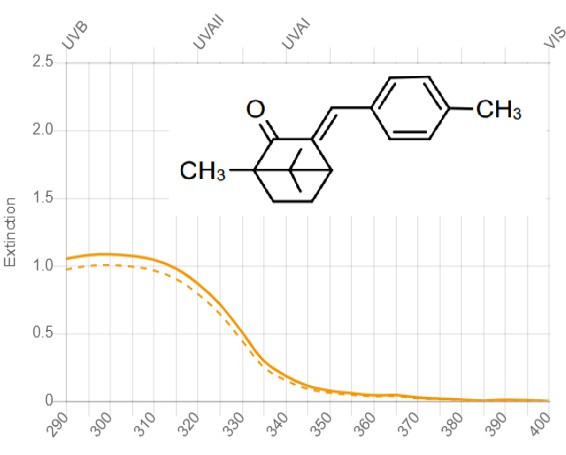
4-Methylbenzylidene Camphor is a chemical sunscreen agent that protects in the UVB range (290-320 nm) with a peak absorbance at 301 nm. It is an oil-soluble powder that is slightly photo-unstable (it takes 65 minutes to lose 10% of its protecting power and 345 minutes to lose half of it), but it can still help to stabilize the famously unstable UVA filter, avobenzone.
Regarding its safety, we do not have the best news. Two possible concerns are that it absorbs into the body and might have some estrogenic activity there. But do not panic, the latter one was only shown in rats and is probably not the case in humans. Still, this is a UV filter that is currently being phased out of use. It is not approved in the US and Japan, and the EU also banned it starting in 2026 (however it is approved in Australia up to 4%).
Evidencia e investigación
-
1
Schlumpf, Margret, et al. "Estrogenic activity and estrogen receptor β binding of the UV filter 3-benzylidene camphor: Comparison with 4-methylbenzylidene camphor." Toxicology 199.2-3 (2004): 109-120.Buscar en PubMed
-
2
Pharmazie 62: 449–452 (2007), Study of the efficacy of 18 sun filters authorized in European Union tested in vitro
Encontrado en productos (318 total)
Наиболее часто встречается в продукции Cancer Council (17 продуктов)