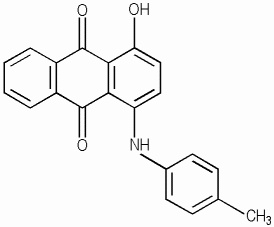
Characteristics
- INCI
- Ci 60725
- Ru.
- Violet 2
- CAS
-
81-48-1
This is the substance number in the Chemical Abstracts Service registry. The CAS number uniquely identifies a substance regardless of language, trade name, or synonyms.
- EC
-
201-353-5
This is the substance number in the European chemical identification system (EC number), used in European regulatory databases including ECHA/CosIng.
- IUPAC
- 1-Hydroxy-4-(P-Toluidino)Anthraquinone
- Functions
- Cosmetic colorant
- EU Restr.
-
IV/89
EU regulatory status: restricted use. The ingredient is permitted in EU cosmetics but its use and labelling are regulated.
More detail →
Description
You might not recognize CI 60725 by its numerical name, but if you've ever used a violet-tinted shampoo or a lavender-hued skincare product, you've likely encountered it. Also known as Violet 2, this ingredient is a synthetic organic dye belonging to the anthraquinone family—a class of compounds prized for their intense, stable coloring properties. Chemically, it's derived from coal tar or petroleum sources, and its molecular structure allows it to absorb light in the yellow spectrum, reflecting back a vivid violet or blue-violet shade. While naturally occurring anthraquinones exist in plants like madder root, CI 60725 is entirely man-made, designed for consistent performance and regulatory compliance in cosmetics.
In cosmetic formulations, CI 60725 serves a straightforward but essential role as a colorant, meaning it imparts color to the product itself or, in some cases, to the skin or hair temporarily. Its mechanism is purely optical—it doesn't chemically react with the skin or alter its biology; instead, it selectively absorbs and reflects specific wavelengths of light to create the desired hue. Formulators choose it for its excellent stability under light and heat, as well as its ability to blend seamlessly with other dyes to produce custom shades. Typical concentrations in finished products are very low—often well under 1%—since even tiny amounts yield intense coloration. It's most commonly found in rinse-off products like shampoos, conditioners, and shower gels, but also appears in leave-on items like creams and serums where a subtle violet tint is desired.
The main benefit of CI 60725 is purely aesthetic, but that doesn't make it trivial. In purple shampoos, for example, the violet pigment helps neutralize unwanted yellow or brassy tones in blonde, gray, or silver hair by counteracting them on the color wheel—a principle called color correction. In skincare, a violet tint can make a product look more luxurious or mask the natural color of certain active ingredients, improving the consumer experience. It's important to note that this ingredient has no proven therapeutic or skin-benefiting effects; its value lies entirely in visual appeal and product differentiation. Evidence for its safety and efficacy as a colorant is well-established through decades of use and regulatory approvals, but it's not a functional active ingredient in the way that antioxidants or peptides are.
CI 60725 is generally considered safe for use in cosmetics at regulated concentrations, but it's not universally suitable for every skin type. People with sensitive skin or a history of allergic reactions to synthetic dyes may experience irritation or contact dermatitis, particularly in leave-on products. It's compatible with most other cosmetic ingredients, including water-based and oil-based formulations, and doesn't typically react with common actives like retinol, vitamin C, or hyaluronic acid. However, because it's a synthetic dye, it may not be suitable for those seeking entirely natural or organic products. Regulatory bodies like the EU and the FDA have approved its use, but restrictions vary by region—for instance, it's allowed in rinse-off products in higher concentrations than in leave-on products. If you have known sensitivities to coal-tar dyes, it's wise to patch-test products containing this ingredient.
When scanning ingredient labels, CI 60725 will appear as either CI 60725, Violet 2, or sometimes simply as "Violet 2 (CI 60725)." It's important not to confuse it with similar-sounding names like "Violet 1" or "Violet 5," which are different dyes with distinct properties. One interesting fact: despite its synthetic origins, CI 60725 is sometimes used in high-end cosmetics for its ability to create a "cool-toned" effect that makes formulas appear more sophisticated or high-tech. You'll rarely find it in products marketed as "clean" or "natural," but it's a workhorse in conventional beauty lines where color consistency is key. If you're avoiding synthetic dyes entirely, look for colorants derived from plants or minerals instead—but remember that natural alternatives often have less stability and vibrancy than CI 60725.
Products with Ci 60725 (359 total)
Most often found in Neutrogena products (17 items)


