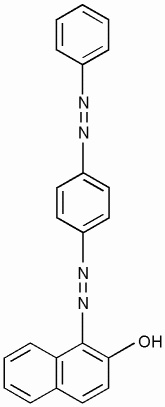
Characteristics
- INCI
- Ci 26100
- Ru.
- D&C Red No. 17
- CAS
-
85-86-9
This is the substance number in the Chemical Abstracts Service registry. The CAS number uniquely identifies a substance regardless of language, trade name, or synonyms.
- EC
-
201-638-4
This is the substance number in the European chemical identification system (EC number), used in European regulatory databases including ECHA/CosIng.
- IUPAC
- 1-(4-(Phenylazo)Phenylazo)-2-Naphthol
- Functions
- Cosmetic colorant
- Irritancy
-
0 / 5
Irritation potential: 0–5, where 5 is the highest irritation rating for the ingredient.
More detail → - Comedogen.
-
3 / 5
Comedogenicity index: 0–5. A non-comedogenic ingredient (0–1) is unlikely to cause cosmetic acne.
More detail → - EU Restr.
-
IV/51
EU regulatory status: restricted use. The ingredient is permitted in EU cosmetics but its use and labelling are regulated.
More detail →
Description
CI 26100, also known as D&C Red No. 17, is a synthetic organic pigment belonging to the class of monoazo colorants. Chemically, it is a red powder derived from petroleum-based intermediates, specifically through the coupling of diazonium salts with aromatic compounds. Unlike natural pigments extracted from plants or minerals, CI 26100 is manufactured in a lab to ensure consistent hue, purity, and stability. It is classified as a "certified color" by the U.S. Food and Drug Administration (FDA), meaning it must meet strict batch-by-batch purity standards for use in cosmetics, drugs, and food products. In its raw form, it appears as a bright red to dark maroon powder that is insoluble in water but disperses well in oils and waxes.
In cosmetics, CI 26100 functions primarily as a colorant and cosmetic colorant, imparting a vivid red or orange-red shade to formulations. Its mechanism of action is purely optical: it absorbs and reflects specific wavelengths of visible light, creating the perceived color. Formulators value it for its excellent lightfastness (resistance to fading under UV exposure) and heat stability, making it suitable for products that undergo manufacturing processes like melting or baking. Typical concentrations range from 0.1% to 2% in lipsticks, blushes, eyeshadows, and nail polishes, though it may be used at higher levels in temporary hair colors or bath products. Because it is oil-dispersible, it is often incorporated into anhydrous or emulsion-based formulas rather than water-based systems.
The main benefit of CI 26100 is its ability to deliver intense, long-lasting color that does not bleed or migrate easily. In lip products, it provides a rich, opaque finish that stays put without feathering into fine lines. In eye shadows, it offers vibrant payoff with minimal fallout. However, evidence for its efficacy is purely anecdotal from formulator reports, as no clinical studies specifically evaluate its cosmetic benefits beyond color delivery. It is worth noting that CI 26100 is not a skin-active ingredient—it does not moisturize, exfoliate, or protect the skin. Its sole purpose is aesthetic, so its "benefits" are entirely visual and tied to consumer preference for bold, consistent shades.
Skin type suitability for CI 26100 is a nuanced topic. It is generally considered safe for most skin types when used within approved concentrations, but it has a comedogenicity rating of 3 on a scale of 0 to 5, meaning it has a moderate to high likelihood of clogging pores. This makes it less ideal for acne-prone or oily skin, especially in leave-on products like foundations or concealers applied to the face. For lip and eye products, the comedogenicity concern is lower since these areas have fewer sebaceous glands. The ingredient has an irritancy rating of 0, indicating minimal risk of irritation or allergic contact dermatitis in the general population. It is compatible with most other cosmetic ingredients, including oils, waxes, silicones, and emollients, but may interact poorly with strong acids or bases, which could alter its color stability.
In practice, you will find CI 26100 listed on ingredient labels as CI 26100, D&C Red No. 17, or simply Red 17. It appears in about 215 products in our database, most commonly in lipsticks, lip glosses, blushes, and nail polishes. A fascinating historical note: D&C Red No. 17 was one of the first synthetic red pigments approved for cosmetic use in the United States in the early 20th century, and it remains a staple due to its versatility. However, its use is restricted in some countries, including the European Union, where it is not permitted in products intended for application around the eyes due to limited safety data. For consumers, expect a vibrant, non-streaky color that lasts well on the skin, but be mindful of its pore-clogging potential if you have reactive or breakout-prone skin.
Products with Ci 26100 (215 total)
Most often found in Moroccanoil products (7 items)


