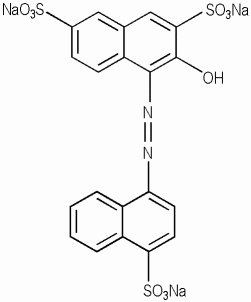
Characteristics
- INCI
- Ci 16185
- CAS
-
915-67-3
This is the substance number in the Chemical Abstracts Service registry. The CAS number uniquely identifies a substance regardless of language, trade name, or synonyms.
- EC
-
213-022-2
This is the substance number in the European chemical identification system (EC number), used in European regulatory databases including ECHA/CosIng.
- IUPAC
- Trisodium 3-Hydroxy-4-(4'-Sulphonatonaphthylazo)Naphthalene-2,7-Disulphonate
- Functions
- Cosmetic colorant
- EU Restr.
-
IV/33
EU regulatory status: restricted use. The ingredient is permitted in EU cosmetics but its use and labelling are regulated.
More detail →
Description
Let’s talk about CI 16185, a synthetic colorant that’s more commonly known in the dye world as Acid Red 27 or Amaranth. Chemically, it’s an azo dye—meaning it contains the characteristic nitrogen‑nitrogen double bond (‑N=N‑) that gives it that vibrant, stable red hue. Originally derived from coal tar in the late 19th century, today it’s manufactured synthetically to ensure consistency and purity. In its pure form, it’s a dark red powder that dissolves easily in water, making it a go‑to for adding a pop of color to everything from lipsticks to bath bombs.
In cosmetics, CI 16185 works purely as a colorant, with no active skincare benefits—it’s all about visual appeal. Formulators use it because it delivers a bright, true red that doesn’t easily fade or shift under light, and it blends well with other dyes to create custom shades. Typical concentrations are very low, often less than 1%, since a tiny amount goes a long way. Regulatory bodies like the FDA and EU CosIng have approved it for use in cosmetics, but with strict limits—for example, the EU caps it at 0.5% in leave‑on products and 0.6% in rinse‑offs. This caution stems from historical concerns about oral ingestion (it was once used as a food dye but is now banned in many countries for that purpose), but in topical cosmetics, it’s considered safe at these levels.
The main benefit of CI 16185 is purely aesthetic: it gives products that unmistakable, eye‑catching red color. Think of a rich cherry lip gloss, a rosy blush, or a vibrant pink shampoo—this dye is often the star behind those shades. It’s especially valued for its stability; unlike some natural colorants that can degrade with UV exposure or pH changes, CI 16185 holds its hue well over time. However, the evidence for its safety is solid but not without nuance—studies show it’s not a skin sensitizer at cosmetic concentrations, but it can cause allergic reactions in a tiny fraction of people, particularly those with pre‑existing sensitivities to azo dyes. So while it’s effective for coloring, it doesn’t do anything for your skin’s health—it’s strictly decorative.
This ingredient is most compatible with all skin types in theory, but it’s not ideal for those with very reactive or allergy‑prone skin. If you have a known sensitivity to azo dyes or coal‑tar derivatives, you might want to avoid products containing CI 16185. It’s often found in rinse‑off products like shampoos, shower gels, and soaps, where exposure is brief, but also in leave‑ons like lipsticks, eyeliners, and foundations. One limitation: it can stain fabrics and skin temporarily, especially in high‑concentration formulas like lip stains or bath bombs. It plays well with other colorants and common cosmetic ingredients, but it’s not compatible with strong oxidizing agents (like hydrogen peroxide) which can break down the azo bond and cause color fading.
On a label, you’ll spot it as CI 16185, and sometimes it’s listed simply as “Amaranth” or “Acid Red 27.” Because it’s a synthetic dye, it’s not vegan or cruelty‑free by default—many manufacturers test on animals, though synthetic production itself doesn’t require animal ingredients. A fun fact: despite its name, Amaranth has nothing to do with the amaranth plant—it’s purely a chemical name. In the U.S., it’s FDA‑approved for cosmetics but banned in food, while in the EU it’s restricted in both. If you’re hunting for a natural alternative, look for carmine (CI 75470) or beetroot extract, though they won’t be as stable or vibrant. In your products, expect that CI 16185 gives a bold, lasting color—just don’t expect it to do anything for your skin beyond looking pretty.
Products with Ci 16185 (182 total)
Most often found in Isana products (7 items)


