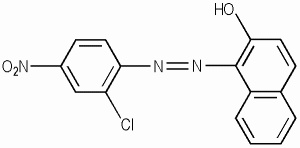
Characteristics
- INCI
- Ci 12085
- Ru.
- Red 36
- CAS
-
2814-77-9
This is the substance number in the Chemical Abstracts Service registry. The CAS number uniquely identifies a substance regardless of language, trade name, or synonyms.
- EC
-
220-562-2
This is the substance number in the European chemical identification system (EC number), used in European regulatory databases including ECHA/CosIng.
- IUPAC
- 1-[(2-Chloro-4-Nitrophenyl)Azo]-2-Naphthol
- Functions
- Cosmetic colorant
- Irritancy
-
0 / 5
Irritation potential: 0–5, where 5 is the highest irritation rating for the ingredient.
More detail → - Comedogen.
-
3 / 5
Comedogenicity index: 0–5. A non-comedogenic ingredient (0–1) is unlikely to cause cosmetic acne.
More detail → - EU Restr.
-
IV/9
EU regulatory status: restricted use. The ingredient is permitted in EU cosmetics but its use and labelling are regulated.
More detail →
Description
Synthetic organic pigments like CI 12085, also known as Red 36, belong to the monoazo pigment family, which are created through a chemical reaction called diazotization followed by coupling. Specifically, CI 12085 is a red lake pigment, meaning it's an insoluble salt formed by precipitating a water-soluble dye onto a metallic substrate, typically aluminum or calcium. This process locks the color into a stable, non-bleeding particle that won't dissolve in water or oil, making it ideal for long-lasting cosmetic applications. While it's entirely man-made, its chemistry mimics natural colorants found in certain plants and minerals, but with far greater consistency and vibrancy.
In cosmetics, CI 12085 functions as a colorant by physically depositing on the skin or hair surface, reflecting specific wavelengths of light to produce a vivid red hue. Formulators rely on it for its excellent tinctorial strength — meaning a small amount delivers intense color — and its stability under various pH levels and light exposure. Typical concentrations range from 0.1% to 5% in lipsticks, blushes, and eyeshadows, though it's rarely used alone, often blended with other pigments to achieve custom shades. Its insolubility ensures it stays put without migrating into fine lines or pores, a critical property for long-wear products.
The main benefit of CI 12085 is its ability to impart bright, true-to-tone reds that resist fading or shifting color over time, even in oil-rich formulas like lipsticks. Unlike some natural reds (e.g., beet extract or carmine), it doesn't oxidize or darken upon exposure to air, so the shade you see in the tube is the shade you get on your skin. However, evidence for its safety is strong — it's approved by the FDA for use in cosmetics (including lip products) and has a low irritancy rating (0 in the database), meaning it rarely causes allergic reactions. That said, its comedogenicity rating of 3 indicates a moderate risk of clogging pores, which is worth noting for acne-prone skin types.
CI 12085 is best suited for oily or combination skin when used in powder or liquid formulas, but those with very oily or acne-prone skin should approach with caution, especially in cream or balm textures that might trap the pigment in pores. It's compatible with nearly all other cosmetic ingredients, including silicones, oils, waxes, and other pigments, and doesn't interact negatively with active ingredients like retinoids or acids. The only limitation is that it's not recommended for use around the eye area in some regions (though it's allowed in the US), and it's not suitable for water-based products without proper dispersion techniques. If you have sensitive or reactive skin, patch testing is wise, though true allergies are exceptionally rare.
When scanning labels, you'll find CI 12085 listed under its Color Index number, often alongside other CI numbers or names like "Red 36 Lake." It's commonly found in vibrant red lipsticks, blushes, and eyeshadows where a punchy, long-lasting color is desired. A fun fact: despite being synthetic, CI 12085 is sometimes used as a replacement for carmine (a natural red from cochineal insects) in vegan cosmetics, since it's entirely animal-free. In our database, it appears in 114 products, suggesting it's a workhorse pigment that formulators trust for consistent, high-impact color. Just remember its comedogenicity rating if you're prone to breakouts, and you'll enjoy its vivid, fade-resistant performance.
Products with Ci 12085 (114 total)
Most often found in Chanel products (15 items)


